
| Back to Library page Page 1 - Page 2 - Page 3 - Page 4 - Page 5 - Page 6 - Page 7 |
|
Inside the amp |
|
 |
|
| Find the 7 x 25uf/25volt caps in the layout diagram above that are highlighted yellow. |
|
| Inside the amp on the main circuit board you will find some small electrolytic capacitors.
They can be different values and different shapes but most of the time the value is 25uf at 25 volt. Sometimes these caps
are double caps with two 25uf caps inside one package and they will share a common negative lead. Older Fenders
had double paper style 25uf/25uf at 25 volts. Later they were doubles with a black body and a burgundy end. Later still
they were a single 25uf/25 volt white waxy looking Mallory cap. All of them are electrolytic caps with a positive end and a negative end. The negative end points towards the pots and the positive end points towards the tube sockets. You will have to look around inside the amp to find them all. Most Fender combo amps have seven caps total. Either 7 single caps or 3 double caps and one single. Smaller amps like Princeton's may have only 6 of these caps. Tweed Fender amps will vary also, you will have to look at the amp to find them all. Some Fenders have one 25uf/25v cap along the back of the amp near the reverb jacks. Where ever they are in the amp, they all need to be changed to new caps regardless of what amp you are working on. These caps make a huge difference in how the amps sounds. And if they are over 10 years old they need to be changed. Sometimes the tremolo section has a 4.7uf cap instead of a 25uf cap. I replace these with a 25uf/25v cap or a 22uf/50v cap. Either cap works fine for a replacement. Look at the Fender combo layout diagram above. This section of the layout diagram shows the 7 caps that need to be changed. The last 25/25v cap is next to the tremolo optoisolator and is the cap highlighted in yellow at the left end of the image above. The first thing to do is remove the 25uf/25v caps from the circuit board and replace all of them with a new 22/50v or 25/25v caps. Unsolder the lead closest to the tube sockets and pull the cap up. The negative lead of some old caps continues through the eyelet and is soldered at the brass plate under the pots. Snip the lead flush at the eyelet, you will leave the wire section that goes from the eyelet to the brass plate. It's a ground wire that you need to leave in place. You can pre bend the leads of your replacement caps so that the bends are directly over the eyelet holes. Snip the new cap leads to the proper length. Heat up the positive side first and push the lead down into the hot solder. I do all the caps positive ends first and then push any shared negative wires into the hole at one time. The positive end usually is black rubber and the negative end is usually aluminum. |
|
| - | |
 There is one more electrolytic cap inside the amp on the bias board. It is usually 25uf/50v, 50uf/50v volt or 50uf/70v. It needs to be replaced also. I use a 47uf/100v cap. A 50 volt rating is not high enough for this cap. Sometimes there is more than 50 volts across this cap, so it is a good idea to raise the voltage rating of this cap to 100 volts. Notice the polarity of this cap. The positive end goes to ground because this cap is smoothing out the negative voltage for the bias circuit. Note that some later silver face Fender's have one of the bias caps inside the cap can with the filter caps. After all the caps are in place and situated properly, go back and add a tiny bit of fresh solder to all the eyelets where you just installed the new caps. This will reflow the old solder because you are adding flux to the old solder. |
|
| - | |
| Power Tube Sockets | |
 |
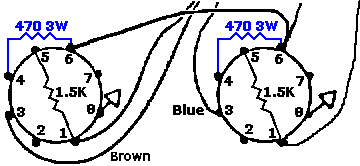 |
| There are two large 470 ohm resistors soldered on the back of the power tube sockets.
If you do not have them, you should add them to your amp. Stock resistors are usually a one watt 470 ohm carbon resistor. Most of
the time they are not 470 ohms any more because they were under rated and should be a higher wattage. Even if they do
read close to 470 ohms I would replace them because I have seen them fail so many times. Replace them with a 470 ohm 3 watt metal film resistor and they will be good to go for a long time. Remove them from the tube socket by carefully heating up the tube socket pins and gently pull each end free. Notice that Fender soldered them over the top of the tube socket. This is not a good idea because the resistor itself and the tube socket generates heat. Notice in the layout diagram above I have hung them out away from the power tube socket. This method works great, I have never had to replace one of these resistors that I installed. The small 1.5K 1/2 watt resistors are ok sometimes and sometimes they are burned up from the heat. Replace them also if necessary. They do not generate heat themselves so it seems to be ok to mount them across the back of the tube socket. Solder them high up away from the socket just to keep the heat from the tube socket to a minimum. |
|
| - | |
| I also change some of the power supply resistors under the capacitor cap while I am changing the filter caps. See page 7 for that info | |
| - | |
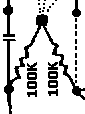 The only other components that I may or may not change on the main
circuit board are the 100K plate load resistors. I only change these if the amp has an excessive amount of hiss when operating. These resistors are in a V shaped pattern usually
but you may have to trace them from the tube socket to find them. Pins 1 and 6 are the plates on the pre amp tubes. You can follow those pins back to the board to find the 100K
plate load resistors. On most Fender combo amps, the phase inverter tube has an 82K and a 100K plate load resistor. These resistors can be the source of bacon frying and hissing
hissing noises. The only other components that I may or may not change on the main
circuit board are the 100K plate load resistors. I only change these if the amp has an excessive amount of hiss when operating. These resistors are in a V shaped pattern usually
but you may have to trace them from the tube socket to find them. Pins 1 and 6 are the plates on the pre amp tubes. You can follow those pins back to the board to find the 100K
plate load resistors. On most Fender combo amps, the phase inverter tube has an 82K and a 100K plate load resistor. These resistors can be the source of bacon frying and hissing
hissing noises. |
|
| Page 1 - Page 2 - Page 3 - Page 4 - Page 5 - Page 6 - Page 7 | |
Enter My Tube Amp Parts Store Here
Mobile users Enter My Tube Amp Parts Store Here
The Tube amp Library of information
Click the link above for Tube amp info, Schematics, Board building information, Projects, Mods, Transformer diagrams, Photo's, Sound clips.
There are hundreds of pages of Tube amp information on my library page.
Please visit my Tube Amplifier Forum
Here's the place you can go to ask tube amplifier questions.
You will find a large community of friendly amp builders at the link above.
Check the huge library of Schematics here
Design your own custom Turret Board or Eyelet board
DIY Layout Creator file analyzer program
DIY Layout Creator file library
Sound clips and tunes of all types
How to email me
|
MEMBER OF PROJECT HONEY POT Spam Harvester Protection Network provided by Unspam |