
| Back to Library page |
Signal flow through a common tube amp circuit |
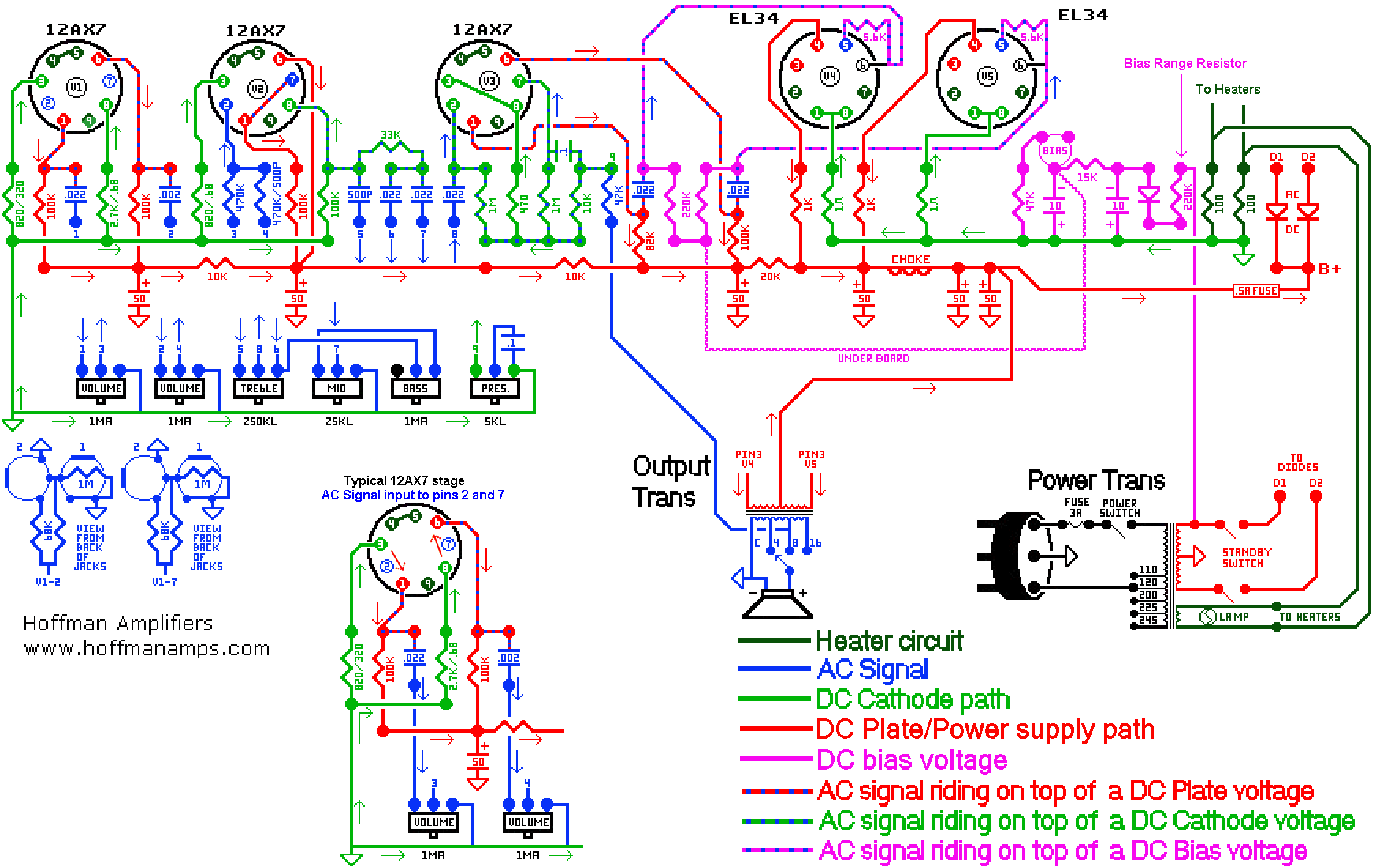 |
| Click on the image above to see a much larger image A new window will open with a much larger image The image above has been squished down so it will fit on most screens |
| A few things must be understood to be able to follow the diagram above. (1) It is possible for an AC signal to ride on top of a DC voltage level. (2) A current flowing through a resistance produces a voltage drop across that resistance. (3) Voltage amplification is achieved by making a small AC voltage control a DC current, then the DC current is turned back into a larger AC voltage across a load. (4) Current flows from negative towards positive. Electrons are attracted to a high potential or voltage. (5) Don't forget that circuits must be complete. The chassis ground is basically one big fat wire. All the ground points above are tied together by the chassis. The main amplifier current paths flow from the center tap of the power transformer, through the chassis, up through all the ground points, through the circuits, through the high voltage power supply and then back to the high voltage red windings. This is a completed loop. (6) The heaters are a separate circuit. Think of heaters as a bunch of light bulbs hooked to 6.3 volts AC. (7) The blue arrows show signal flow through the amp. This is not a flowing DC current, it is Alternating AC. |
Example 1: Lets say we are standing at the shore of a completely smooth fresh water lake that is 10 feet deep all the way across. Now lets say a huge 500 pound fat guy jumps off of a dock at the other end of the lake. He creates a wave that is 5 feet higher than the lake surface. The wave also dips down below the lake surface 5 feet. You are on the other side of the lake and you can see the wave coming towards you but you can only see the top 5 feet of the wave. This wave is actually 10 feet high if you consider that the valley of the wave is 5 feet below the lake surface and the wave peak is 5 feet above the lake surface. This wave is 10 feet high peak to peak. The lake surface is like a constant DC voltage in an amplifier power supply that measures 10 volts DC above chassis ground and the wave is equivalent to a 10 volt peak to peak AC signal voltage riding on top of a that steady 10 volt DC. The AC signal fluctuates the smooth 10 volt DC voltage level up and down to a 5 volt DC low level and a 15 volt DC high level. In a nutshell: Take a look at the Typical 12AX7 stage in the diagram above. A tube/valve amplifies a voltage by taking a very small AC voltage that is present on the input control grid (pin 2) and makes the current fluctuate through the tube from the cathode (pin 3) to the plate (pin 1). This fluctuating current flows through a 100K plate load resistor and is turned back into a much larger copy of the AC control grid voltage on the other side of the plate load resistor. When a fluctuating DC voltage comes up against a coupling capacitor the fluctuating AC level appears on the other side of the capacitor but the smooth DC voltage component is blocked. Capacitors will block a smooth DC voltage but will appear to pass the fluctuating AC voltage component. Details: The input control grid is able to repel or hold back and attract or allow electrons to flow across the vacuum gap between the cathode and the plate. The input control grid is between the cathode and plate physically. The electrons are repelled back to the cathode or attracted away from the cathode by the control grid voltage. When the electrons see the higher voltage of the plate, they are attracted to the plate, not the control grid. They pass right on by the control grid and make a bee line to the plate. The higher the negative voltage level (more negative) at the control grid, the more it can hold back or repel the electron flow from cathode to plate. The lower the negative control voltage is (less negative), the more the electrons are allowed to flow from cathode to plate. Of course the AC control grid voltage is always fluctuating up and down and so the current flow through the tube is always fluctuating up and down following the sine wave of the control grid voltage. A DC current flows up through the 820 ohm cathode resistor from ground and into the vacuum tube, when the control grid allows current to flow. The DC current flowing through the 820 ohm cathode resistor produces a voltage drop across the top of the cathode resistor. This makes the top of the cathode resistor a positive DC voltage level with respect to the control grid and this sets the bias point of the tube. If the cathode is a positive DC voltage then the control grid is going to be a negative value with respect to the cathode voltage. The control grid is tied to ground through a resistance. In our 12AX7 example above, the control grid ground resistance is part of the input jacks. If you measure from pin 2 to ground you would get a resistance reading of 1 meg. This is only if an open dummy jack is inserted into jack number one. If the DC voltage on at the top of the 820 ohm cathode resistor is +1 DC volt, then we could conceivably introduce a 2 volt peak to peak input signal to our negative control grid without making the control grid go to some positive value. The control grid should not go to some positive value technically. If the control grid is positive with respect to the cathode, it will start to attract the electrons that were on the way to the plate. If the control grid attracts too many electrons, it will start to flow a current. Control grids are not meant to flow current, they are only there to present a voltage potential. A control grid that flows too much current will fail and the tube will fail. A cathode biased amplifier stage has the added benefit of being self biased. The more current the tube flows, the higher the voltage drop across the cathode resistor. The higher the cathode voltage, the more negative with respect to the cathode the input control grid is. The more negative the input control grid is, the more it repels electrons back to the cathode. This is kind of like a governor on an engine. Example 2: The input control grid and resulting tube current can be compared to a person that is holding a garden hose that has a spray nozzle on the end of the hose. It takes just a little hand pressure to squeeze the nozzle and this let lots of water flow out of the hose. The nozzle handle is the control grid, your hand is the AC voltage that is present at the control grid and the water flowing out of the hose is the current flowing through the tube. I don't have an example of what happens next. I guess the water stream could turn a wheel and be made to do some work. This would be a small pressure from you fingers controlling a much larger force. The fluctuating current through the vacuum tube flows from the cathode, through the vacuum and then out the plate. It then flows through the 100K plate load resistor. The fluctuating DC current appears on the other side of the 100K plate load resistor as a varying DC voltage drop. The .022 coupling capacitor is connected to the plate load resistor. Capacitors do not pass smooth DC voltage through them but an AC voltage component can appear on the other side of the capacitor. The voltage is developed on the other side of the capacitor because it is referenced to ground through some sort of resistance. In our 12AX7 example above, the .022 coupling cap is connected to a 1 meg pot that is connected to ground. There is a constant 1 meg resistance from the .022 coupling cap to ground. The amplified AC control grid signal is now ready to be passed onto another stage of amplification. |
Enter My Tube Amp Parts Store Here
Mobile users Enter My Tube Amp Parts Store Here
The Tube amp Library of information
Click the link above for Tube amp info, Schematics, Board building information, Projects, Mods, Transformer diagrams, Photo's, Sound clips.
There are hundreds of pages of Tube amp information on my library page.
Please visit my Tube Amplifier Forum
Here's the place you can go to ask tube amplifier questions.
You will find a large community of friendly amp builders at the link above.
Check the huge library of Schematics here
Design your own custom Turret Board or Eyelet board
DIY Layout Creator file analyzer program
DIY Layout Creator file library
Sound clips and tunes of all types
How to email me
|
MEMBER OF PROJECT HONEY POT Spam Harvester Protection Network provided by Unspam |