
| Back to Library page | |
How a bias circuit worksAdding a bias pot to a Princeton Reverb and other amps |
|
 |
 |
| Layout diagram | Schematic |
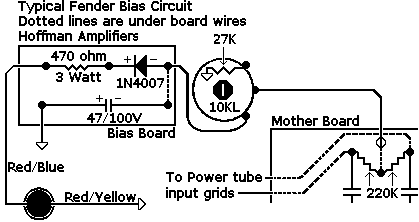
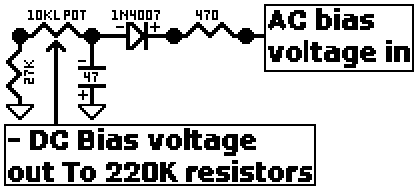
| Here we have a typical Fender bias circuit. The AC voltage comes from the Red/Blue wire on the power transformer. The center tap, Red/Yellow wire, is the other end of the transformer winding. The Red/Yellow wire is grounded to the chassis to complete the bias circuit. The AC voltage from the power transformer Red/Blue wire then goes to the 470 ohm bias range resistor which knocks the AC voltage down a bit. The AC voltage then enters the bias diode and gets rectified into a fluctuating negative DC voltage. The negative DC voltage is then smoothed out by the 47uf at 100 volt bias capacitor. The smoothed negative DC bias voltage then enters the bias pot. The other end of the bias pot has a 27K 1/2 watt resistor that is soldered to ground. The total resistance for this circuit to ground is 10K + 27K or 37K. The bias pot and 27K resistor form a voltage divider. The middle wiper of the bias pot sweeps across the 10K resistance of the bias pot and selects the voltage that gets sent to the power tubes. The negative voltage then leaves the middle wiper of the bias pot and goes to a junction where two 220K 1/2 watt resistors are soldered together at one end. The bias voltage goes through each of the 220K resistors and appears at the two junctions. Each of these two junctions have a wire that leads to each power tube input grid, pin 5. Usually the bias voltage goes through a 1.5K grid stopper resistor first and then on to pin 5 of the power tube. That is the complete bias Circuit complete from transformer to power tube. Notes: The 470 ohm bias range resistor value determines the sweep of the bias pot. If you want to change the voltage range that the bias pot sweeps across, change this resistor up or down in value to move the sweep up or down. A smaller value will give you more negative voltage in the bias circuit. More negative voltage means less current flowing in the power tube. A larger value bias range resistor will drop the overall voltage of the bias circuit. Less negative voltage means more current flowing in the power tube. Example: You can't get the current any higher than 20MA for each power tube and the bias pot is turned all the way up. You have too much negative voltage in the bias circuit. Make the bias range resistor larger in value and try again. Keep adjusting the bias range resistor until you can get the bias pot to sweep higher and lower than the desired voltage. If you want to be able to bias each power tube at 35ma of current, adjust the bias range resistor until you can get more than 35ma when the bias pot is turned all the way one way and less than 35ma when the bias pot is turned all the way the other way. If the bias diode is installed backwards the bias voltage would be positive which is wrong Notice the bias capacitor polarity. It is installed in this direction because the voltage is negative. If the 47/100v cap was installed backwards it would heat up and explode because the polarity was wrong. Many Fenders have a 25uf at 50 volt bias capacitor or a 50uf at 50 volt bias capacitor. A 50 volt rating is not high enough for the bias circuit. Replace both style capacitors with a 47uf at 100 volt capacitor for safety. The 27K resistor on the bias pot ensures that the path to ground can never be zero ohms. If the bias pot was turned to zero ohms, you still have the 27K resistor in the path to ground. If the 27K resistor was not there and you turned the bias pot to zero ohms, that would short the negative bias voltage directly to ground and probably harm the power transformer or hopefully it would blow a fuse and save your power transformer. Any time you have a current flowing in a circuit and it goes through a resistance you get a voltage drop. This is how a bias pot selects the bias voltage. The sweep of the pot taps into this dropping voltage that appears along the whole 10K resistance of the bias pot. Notice the two capacitors that are soldered at the junction of the two 220K resistors. The signal from the phase inverter enters through each of those two coupling capacitors. The signal rides on the negative bias voltage. The negative bias voltage goes up and down depending on the signal waveform. This is how you get distortion. If the incoming signal is 70 volts ac peak to peak and you have a negative bias voltage of -35 volts dc. Your bias voltage will swing from 0 volts to -70 volts dc as the signal ac sine wave fluctuates up and down. The negative DC bias voltage cannot get across the two coupling caps and the positive DC voltage on the phase inverter side of the coupling caps cannot get across the coupling cap. A properly working coupling cap blocks DC voltage and will only pass AC voltage. If a coupling cap ever starts to leak, the positive DC voltage on the phase inverter side of the coupling cap will alter your negative bias voltage on the bias voltage side of the cap. A positive DC voltage added to a negative DC voltage equals a more positive bias voltage. This will have the effect of raising the current flow on one power tube or both. The power tube(s) can get red hot from not enough bias voltage and you can permanently damage your power tubes. To check to see if a coupling cap is leaking DC voltage, you must unsolder the cap at the bias voltage end and measure with a meter to see if any of the positive DC voltage from the phase inverter side is leaking through the cap. With one end of each cap hanging in mid air, you should get a reading under 100 millivolts if the cap is ok. If you even get a 1/2 volt reading, this is enough to mess with the tone and the bias voltage. The same thing applies to all coupling caps elsewhere in the amp. Always unsolder the end of the cap that is opposite the end with the high voltage on it. A cap that is soldered into the circuit can give you a false reading because the cap may have a path to ground. Always unsolder and lift one end of the coupling cap to check for leaking DC voltage. The amp must be on and running to do this so be very careful. Turn the amp off, unsolder one end of the coupling cap and then turn the amp back on to take your reading. |
|
| - | |
 |
 |
| Layout diagram | Schematic |
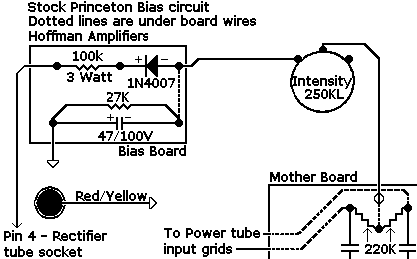
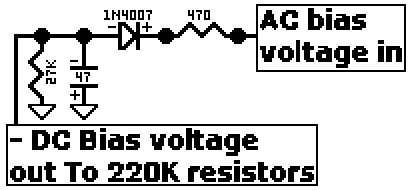
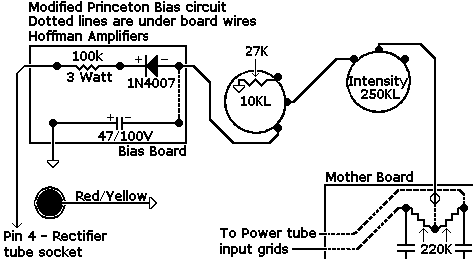
| The Princeton, Princeton reverb and some other Fender's do not have an adjustable
bias pot but the circuit works the same as the circuit described above. The AC bias voltage does not come from a special bias tap. The AC bias voltage comes from pin 4 of the rectifier tube. Pins 4 and 6 is where the high voltage secondary's connect to the tube rectifier. This AC voltage is much higher than what a dedicated bias tap puts out so it must be brought down quite a bit to use for the bias voltage. The AC bias voltage then goes to the 100K bias range resistor. This resistor knocks the AC voltage down to an acceptable level and then it enters the bias diode. The other end of the bias diode has a 47/100v bias smoothing cap and a 27K resistor. The 27K resistor is sometimes a different value in some amps. The 27K resistor replaces the bias pot and 27K resistor that appears in the circuit at the top of this page. The 27K resistor is your bias pot, you just can't adjust it like you can a pot. You must adjust the value of this resistor up or down to adjust the bias. The other end of the 27K resistor is connected to ground just like in the bias pot circuit above. See the notes in the section above on how to select the correct bias current. You should not make the 27K resistor less than about 10K or you will have too large of a current drain to ground. If you need a smaller value than 10K to get the amp biased properly, you should adjust the 100K bias range resistor which is a course adjustment. Go back and adjust the 27K for your fine adjustment after you have adjusted the 100K bias range resistor. The schematic to the right of the layout diagram shows the negative bias voltage going to the two 220K resistors. Actually it makes a stop at the intensity pot first and then on to the two 220K resistors. Notice the only difference from the schematic at the top of the page is a bias pot. |
|
| - | |
 |
|
| This is the same Princeton circuit as above except we have added a bias pot and
removed the 27K resistor from the bias board. The pot can be mounted on the chassis or anywhere you like. You can re-use the 27K resistor that you removed from the bias board. Just solder one end to the right hand pot tab and the other end gets soldered to the back of the pot to make it's ground connection. If the pot shell is not grounded, you will have to solder the resistor to an actual spot that is grounded. |
|
| - | |
 |
|
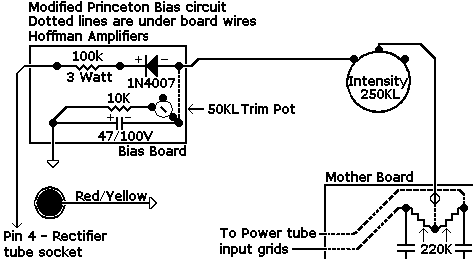
| In this bias circuit version I have used a mini 50KL trim bias pot instead of a chassis mounted bias
pot. The trim pot is being used as a variable resistor instead of a sweep able voltage divider. The rear leg of the trim pot is soldered to the same hole where the 47/100v bias cap is soldered. The right leg of the trim pot is not used. The left leg of the trim pot is soldered to a 10K 1/2 watt resistor. This resistor is here so that if you turn the trim pot to zero ohms, you will still have 10K resistance and you cannot short out your bias voltage directly to ground. The other end of the 10K resistor is soldered to the grounded point on the bias board. I have used a 50KL trim pot so that you can select a bias resistance from 10K to 60K. This is usually enough sweep that you do not have to adjust the 100K bias range resistor. You have 10K when the bias pot is zero ohms and you have 60K when the 50k pot is all the way up at 50K. I have been using this circuit to add a bias pot to Princeton's and other amps for years. It works very well and is very easy to install. I stock trim pots and the fender style chassis mounted bias pots on my web site catalog Bias pots are listed on this page |
|
 |
 |
| Layout diagram | Schematic |
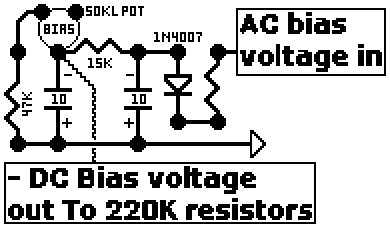
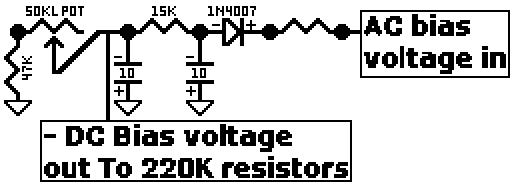
| Better bias system This is the bias system that I use on the Hoffman turret boards like the 5F6A Bassman and Plexi boards. Notice it has one more stage of filtration than the simple Fender bias system. After the diode there is a 10uf/100v filter cap. The negative bias voltage then goes through a 15K divider resistor that isolates the next stage from the previous stage. The bias voltage then is filtered again by the second 10uf/100v cap. From there it enters the bias pot, which is wired like a variable resistor. The 47K resistor on the other leg of the bias pot ensures that the bias voltage can never short out directly to ground when the bias pot is turned to zero ohms. Notice that one leg of the pot is not connected to anything. This is what makes it a variable resistor. |
|
Enter My Tube Amp Parts Store Here
Mobile users Enter My Tube Amp Parts Store Here
The Tube amp Library of information
Click the link above for Tube amp info, Schematics, Board building information, Projects, Mods, Transformer diagrams, Photo's, Sound clips.
There are hundreds of pages of Tube amp information on my library page.
Please visit my Tube Amplifier Forum
Here's the place you can go to ask tube amplifier questions.
You will find a large community of friendly amp builders at the link above.
Check the huge library of Schematics here
Design your own custom Turret Board or Eyelet board
DIY Layout Creator file analyzer program
DIY Layout Creator file library
Sound clips and tunes of all types
How to email me
|
MEMBER OF PROJECT HONEY POT Spam Harvester Protection Network provided by Unspam |