
Garden Tools, Buckets, Soil, Water and Fertilizer info |
|
| Back to main Garden page | |
| - | |
 |
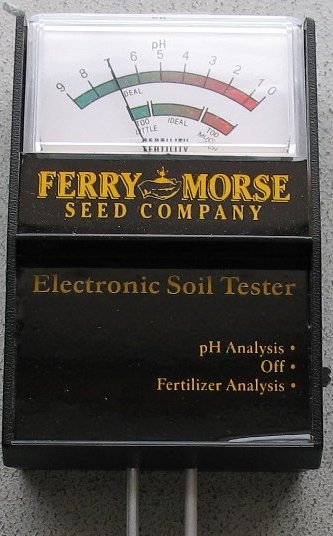 |
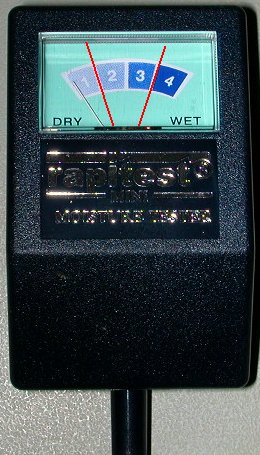
| My moisture meter | My pH tester |
| I use a moisture meter to get my water levels correct. The meter stopped me from guessing how wet the containers were deep down. Using the meter changed my watering habits and stopped over and under watering. I keep the container levels between the red lines. I just bought the Electronic soil tester so I don't know how well it works yet. | |
 |
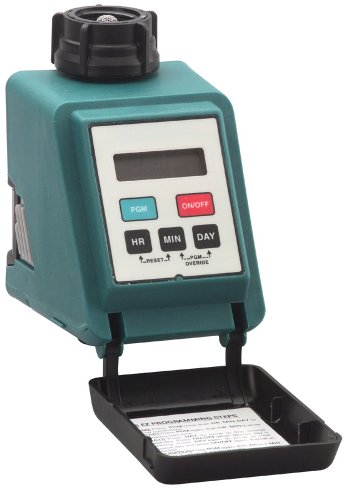 |
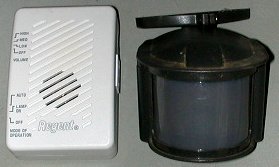
| Sensor and base unit | I use the timer above to turn on my drip irrigation system automatically |
| The sensor unit above senses heat and motion. I have the sensor turn on some flood lights near the garden and the base unit will ding when something trips the sensor. The base unit can also turn on lamps or other electrical items. You can get these sensors at Lowes home center for about $30. I have deer near the garden all the time but not one has approached my garden and eaten my plants. (So far) | |
| The 5 Gallon buckets |
| A friend of mine owns a small bakery. He gets Honey and molasses in 5 gallon buckets for baking cookies, etc. He saves the 5 gallon buckets for whoever wants them. These buckets are $5 each in Lowes but I got about 40 of them free. If you check with your local bakery you may be able to get a load of free buckets also. |
| Click on the images for a larger image |
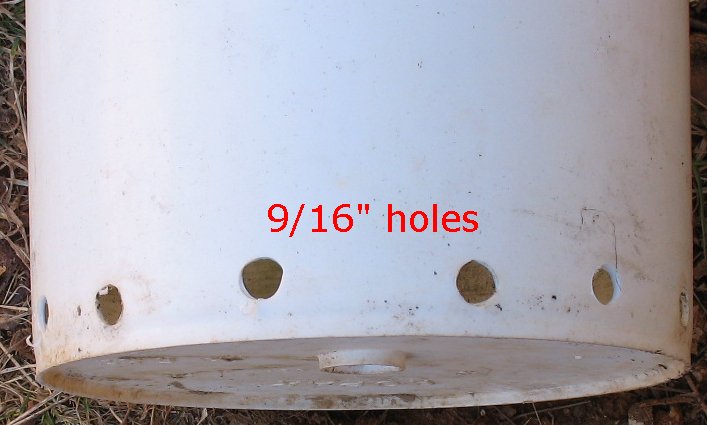 |
| Bucket Holes |
| I drill drain holes on the sides of the buckets at the very bottom. This lets the water drain out without having to elevate the bucket up in the air, which
you would have to do if you had the drain holes on the bottom of the bucket. I use a regular 9/16" spade type wood drill bit to drill the holes. The plastic drills very easy. Note for January 2007: I just pulled all my buckets out and drilled holes in between the existing holes which doubled the number of bucket drain holes. I wasn't having any drainage problems or wet soil problems, it just seemed like a good idea and now is the time to do it. So now all the buckets have 10 or more 9/16 inch holes along the bottom edge. The pictures looks as though the holes are not at the very bottom of the bucket but they are. If you look at the very bottom of the bucket, you can see there is Ridge that the bucket sets on that is about 3/8" off the ground. |
| - |
| Click on the images for a larger image |
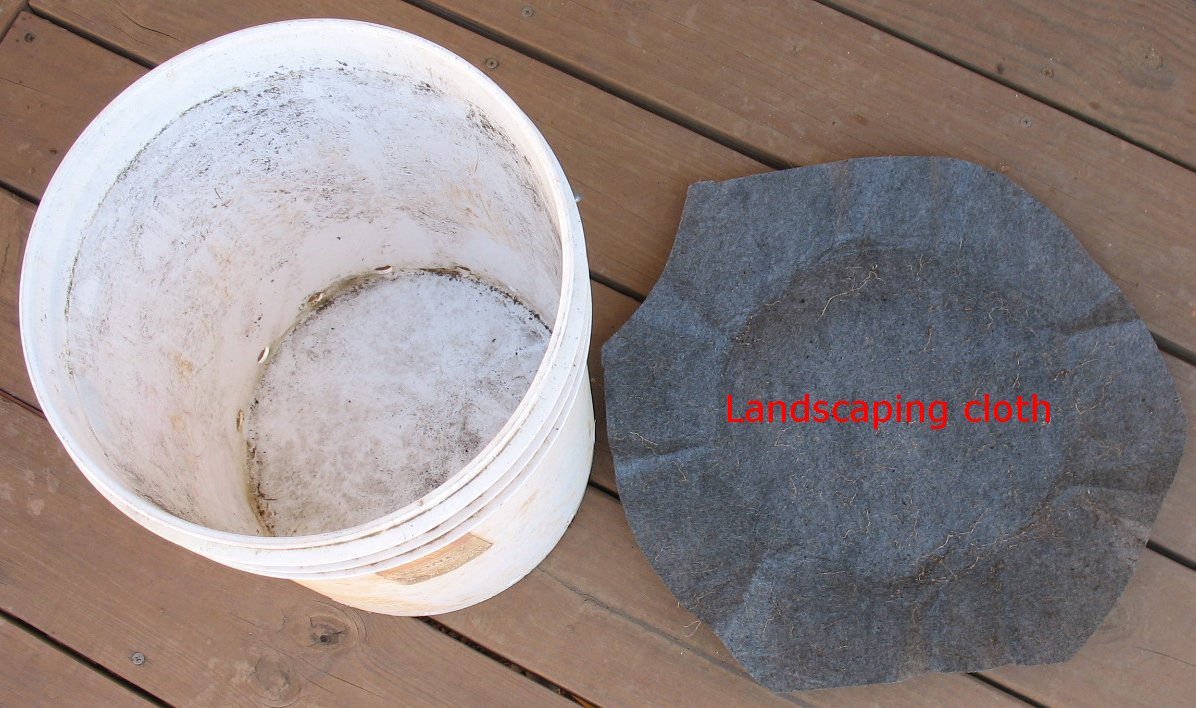 |
| Bucket and landscape cloth |
| I place a piece of landscape fabric in the bottom of all my buckets which acts like a coffee filter. It lets the water out of the bucket and it keeps the soil from clogging the holes and getting out of the bucket. It also keeps insects from getting into the bucket through the drain holes. |
| - |
| Click on the images for a larger image |
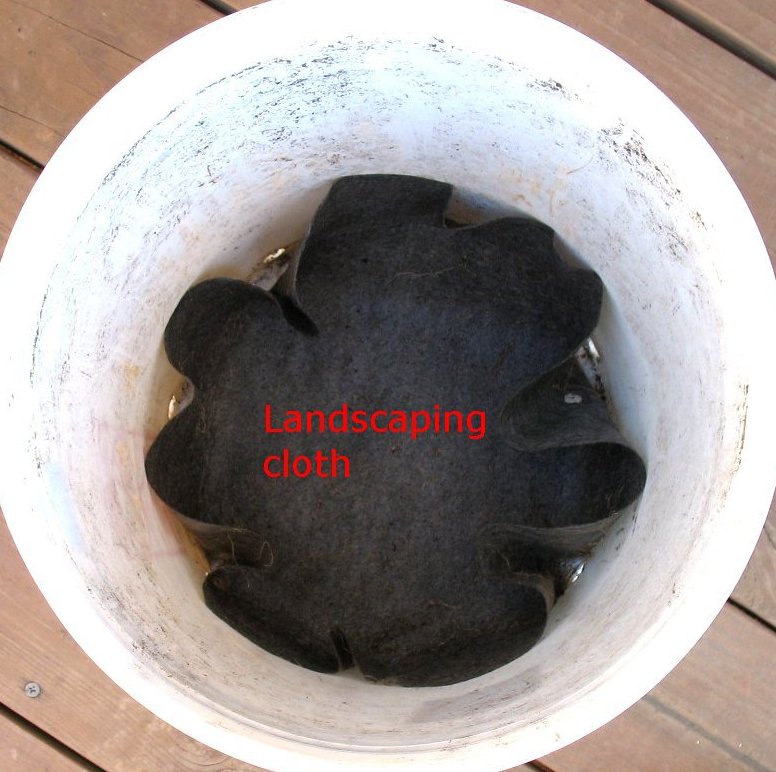 |
| Bucket with landscape cloth inserted |
| - |
| Click on the images for a larger image |
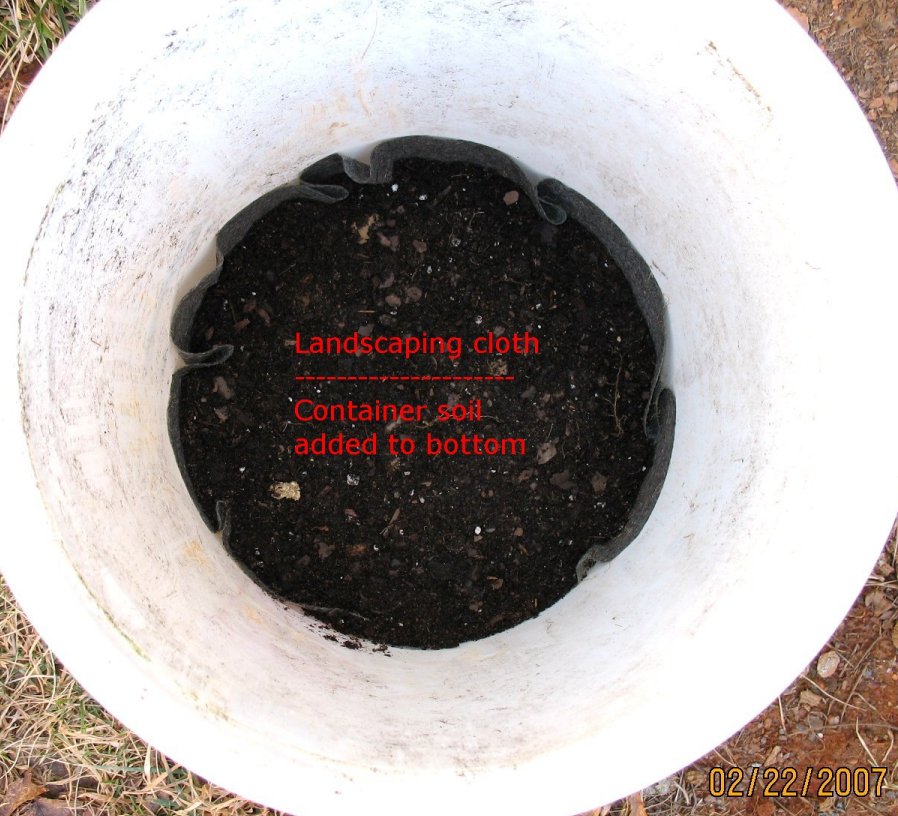 |
| Bucket with landscape cloth and a bit of container soil added to push fabric out to the sides of the bucket |
| - |
| Click on the images for a larger image |
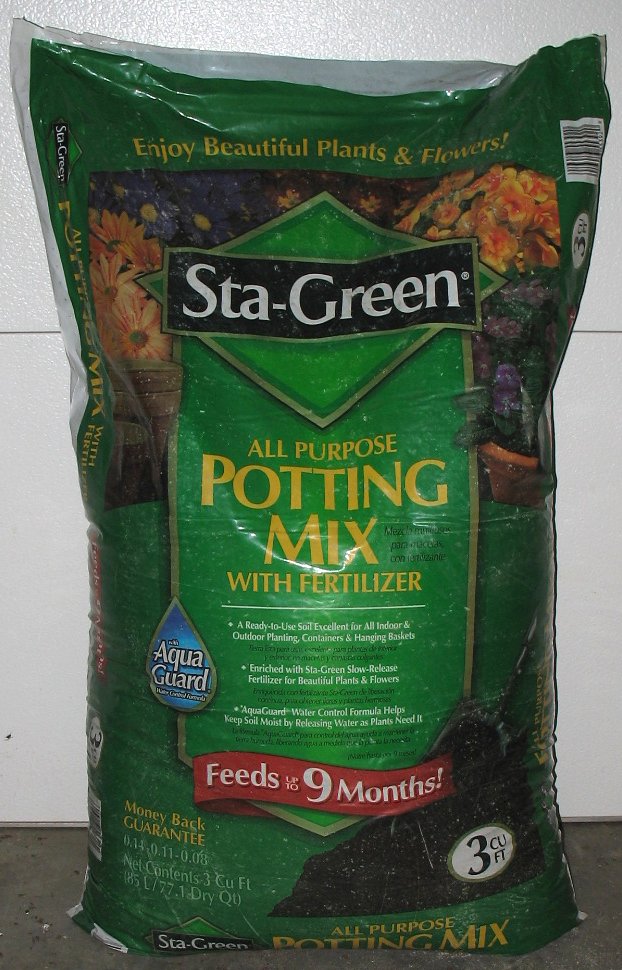 |
| Here's the container soil I use in all my buckets. I also use it in the dug out trenches in my garden. It's a big 3 cubic foot bag. I can fill 3 1/2 of the 5 gallon buckets with one bag. The soil seems to vary every time I buy a batch. Sometimes it has a bunch of pine bark and is fairly coarse, which is what I prefer and sometimes it feels a bit denser and more dirt like. If you pick up a dry bag, you can get a feel for how fluffy or dense the contents are inside. |
| - |
| Fertilizer |
| The Sta-Green soil I use has fertilizer in it but I like to add my own brew to my buckets and in-the-ground trench plantings. I use miracle grow 15-30-15 at the
rate of 1 teaspoon per gallon of water. Each bucket gets a 16 ounce cup poured into it once a week. Depending on how big the plant is, I may add a bit more or less. Every
two weeks I also add 1 teaspoon per gallon of Epsom salts to my fertilizer mix. Warning: All miracle grow is not the same. You have to check the package info on all miracle grow packages. They have all kinds of ratio's available. They even have some that are 36-6-6 which is very high in Nitrogen. You would not want to use a 36-6-6 on veggies that have root crops like carrots or veggies that have fruit like peas, broccoli, etc. High nitrogen fertilizers work good for crops like lettuce and grass but you have to be careful. For most veggies that put out fruit or root crops you want a higher middle number in the formula. The 15-30-15 I use seems to work out very well. It's not mixed up too heavily at 1 teaspoon per gallon, the mix is fairly weak and ends up being kind of a constant feeding situation. Every once in a while I flood the buckets with water until water runs out all the holes in the bottom. This tends to flush away any salts build up from the fertilizer. Growing in bucket the way I do is closer to a hydroponics situation than an in the ground dirt garden. The plants root systems fill every corner of the buckets and may not get enough nutrients unless you supply it by fertilizing. |
| - |
| Watering notes |
| Some of my 5 gallon buckets need lots of water and some only need half as much. That's because plants suck up water and transpire water through their leaves.
A small green pepper plant only has so much foliage and will use much less water than a 10 foot high Juliet tomato plant or a 6 foot high cucumber plant with several horizontal branches.
A good example is that my sugar snap pea buckets can be watered every day and sometimes twice a day but my just starting out tomato plants only need water every 3 or 4 days. When
the tomato plants get big, they will use lots more water. But for now, it would be easy to kill them while they are just developing their root system if the roots stayed soaking
wet 24 hours a day. Cool night temperatures and constantly wet roots will kill some veggies very easily before they get a chance. That's where the moisture meter I use comes in real handy. It's very easy to over water plants like small cucumber plants. The bucket soil may stay too wet and kill the plant when it is just trying to get going. After the plant gets a good root system and needs more water, you can see with the meter exactly what it needs without guessing. The meters are cheap and made a huge difference in how well my 5 gallon bucket plants did overall. See the picture of my moisture meter at the top of this page. |
Enter My Tube Amp Parts Store Here
Mobile users Enter My Tube Amp Parts Store Here
The Tube amp Library of information
Click the link above for Tube amp info, Schematics, Board building information, Projects, Mods, Transformer diagrams, Photo's, Sound clips.
There are hundreds of pages of Tube amp information on my library page.
Please visit my Tube Amplifier Forum
Here's the place you can go to ask tube amplifier questions.
You will find a large community of friendly amp builders at the link above.
Check the huge library of Schematics here
Design your own custom Turret Board or Eyelet board
DIY Layout Creator file analyzer program
DIY Layout Creator file library
Sound clips and tunes of all types
How to email me
|
MEMBER OF PROJECT HONEY POT Spam Harvester Protection Network provided by Unspam |